Is the Gallery Model Broken?
A changing art market, and the search for new ways of connecting artists, collectors and works
At a recent conversation at TheMerode in Brussels, Marc Spiegler, former Global Director of Art Basel, raised a question that is becoming increasingly difficult for the art world to ignore: is the traditional gallery model still fit for purpose?
The question is not whether galleries still matter. They clearly do. Galleries remain essential to the discovery and development of artists, and to the relationship between artists and collectors.
The question is whether the business model that has developed around them over the past decades can continue to sustain itself.
In his recent New York Times essay, Art Galleries Are Not OK, Spiegler argues that the art world has expanded dramatically while the underlying market has not grown at the same pace. More galleries, more international locations, more fairs, more travel and more staffing have created an increasingly expensive infrastructure around a market that has remained comparatively flat. (artbasel.com)
The numbers are revealing. According to the latest Art Basel and UBS Global Art Market Report, worldwide art sales reached an estimated $59.6 billion in 2025, up 4% from the previous year but still below the market's 2022 peak. Dealer operating costs, meanwhile, rose by an estimated 5% in 2025, compared with only 2% growth in dealer sales. (artbasel.com)
The fair system is a visible part of this problem. International art fairs have become indispensable places for galleries to meet collectors and present artists. Yet participating in an ever-expanding circuit of fairs also brings travel, shipping, staffing, stand costs and hospitality expenses.
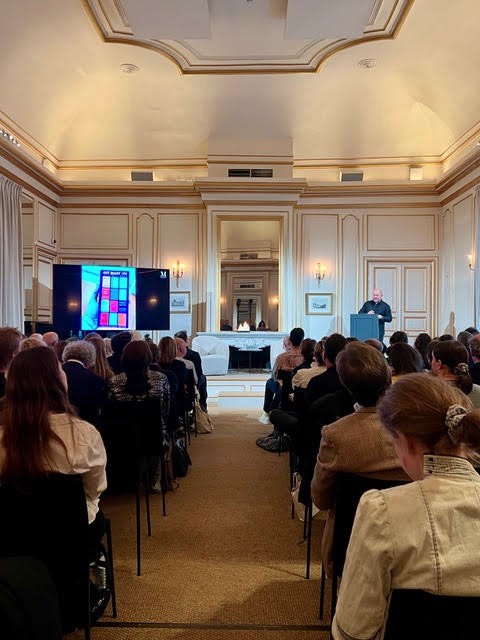
As Spiegler puts it, “FOMO is not a business model.”
His argument is not that galleries should disappear, or that fairs have become irrelevant. Rather, he suggests that the art world may need to become more focused, selective and sustainable.
From couture to accessibility
Another perspective comes from artist Alvaro Barrington, who in last week's Financial Times pointed to an even broader issue: scale and accessibility.
The comparison is striking. Around 2011, the global art market generated approximately $64.6 billion in sales, while LVMH reported revenue of €23.7 billion, roughly $33 billion at the average exchange rate of the time. The global art market was therefore almost twice the size of LVMH. (ubs.com)
Today, the relationship has reversed. The global art market generated $59.6 billion in 2025, while LVMH reported revenue of €80.8 billion, equivalent to roughly $91 billion at the 2025 average exchange rate. On this basis, LVMH is now around one and a half times the size of the global art market. (artbasel.com)
The comparison is not perfectly like-for-like (LVMH revenue and total art-market sales describe very different businesses), but the shift in relative scale is nevertheless remarkable.
Barrington's broader point is that some parts of the art world continue to operate like haute couture: highly exclusive, expensive and built around scarcity. He suggests that the sector may also need to think about accessibility and about creating more points at which people can enter the market.
This raises an interesting question: does the future of the art market depend not only on selling more to existing collectors, but on making art accessible to a much broader group of potential buyers?
There is an instructive contrast in the luxury sector. In a conversation I once had with the regional director Europe and Middle East of LVMH, he told me that sales teams were encouraged to treat a new or relatively small customer with the same attention as a long-standing client, even when the initial purchase might be no more than an accessory. The underlying logic was clear: customer acquisition matters, and today's small customer may become tomorrow's loyal client.
That philosophy is worth considering in the art world. The first encounter between a collector and an artist does not necessarily have to begin with a major purchase. Creating accessible entry points may be one of the ways in which the art market can broaden its audience and build the next generation of collectors.
From infrastructure to access
The traditional gallery model, built around physical premises, a roster of artists and long-term representation, is no longer the only way in which artists and collectors can interact.
A work does not necessarily need to be in a gallery to be discovered. A collector does not necessarily need to walk into a gallery to find a work. And a transaction does not necessarily need to pass through a traditional gallery structure in order to be trusted and professionally documented.
Digital platforms have already changed the way collectors discover art. The next challenge is to create enough confidence around the transaction itself: provenance, authenticity, condition, ownership and reliable information.
This is where new models may have an opportunity.
At TAGALART, we are interested in precisely this space: not in replacing galleries, but in exploring a more direct relationship between existing owners of contemporary art and collectors looking for specific works.
The idea is deliberately simple. Works remain with their owners rather than being transferred into gallery inventory. TAGALART focuses on discovery, information and trust, including checks on provenance and authenticity, while the buyer and seller remain directly connected for the transaction.
It is a different approach to the traditional infrastructure of the art market: less overhead, more direct access; less intermediation, more transparency.
Perhaps the future of the art market will not belong to a single model.
Galleries may become more focused and selective. Fairs may become fewer and more meaningful. Agents, digital platforms and direct collector networks may occupy a larger role. And collectors may increasingly move between these different structures depending on what they are looking for.
The art market is not disappearing. It is recalibrating.
The more interesting question is therefore not whether the old model will survive unchanged, but what the next art market should look like, and how many more people it might be able to reach.
September 2026, by Francis Vanhoonacker
Een werk verkopen, of weten wat het waard is? Wij maken vrijblijvend een inschatting.Selling a work, or want to know what it is worth? We make a no-obligation estimate.
Gratis waardebepalingFree appraisal