Paris Internationale: Space to Look, Room to Discover
A personal selection from one of the highlights of Paris Art Week
Art Basel Paris was an excellent fair this year, with an impressive range of international galleries and artists. Yet one of my most rewarding visits during Paris Art Week was to Paris Internationale, the independent fair that has steadily established itself as an important alternative to the traditional art-fair format.
What I particularly appreciated was the generous setting and the restraint of the presentations. Many stands focused on just one or two artists, giving the works space to breathe and allowing visitors to engage with an artist’s practice rather than simply move from one artwork to the next. It is a seemingly simple approach, but one that makes a real difference: the experience becomes less about seeing as much as possible and more about looking carefully.
This year’s edition brought together an international selection of galleries in a setting that encouraged exploration. The atmosphere felt focused and considered, and the overall artistic level was remarkably strong. Paris Internationale’s independent, gallery-led approach continues to create room for unexpected encounters between emerging voices and more established practices.
Among the artists whose work caught my attention were several whose approaches could hardly be more different, yet whose work stayed with me long after leaving the fair.
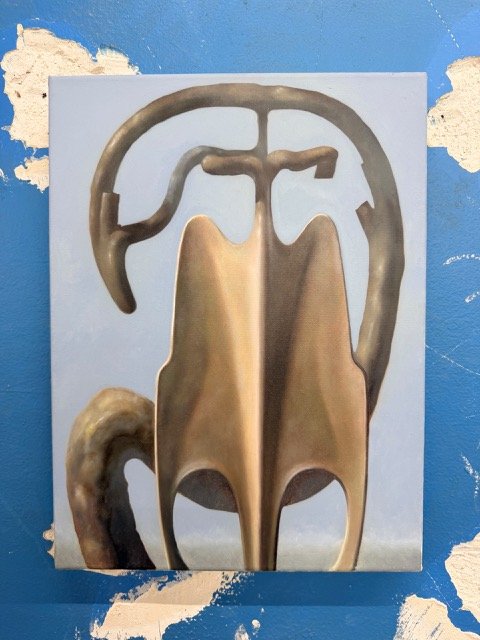
Noah El Hachem
The paintings of Noah El Hachem are carefully constructed compositions in which profiles, recurring objects and empty spaces become elements of an almost architectural arrangement. Rather than presenting a fully formed scene, his paintings draw attention to how images are built, layer by layer. There is a striking tension between the precision of the composition and the quiet, meditative atmosphere it creates.
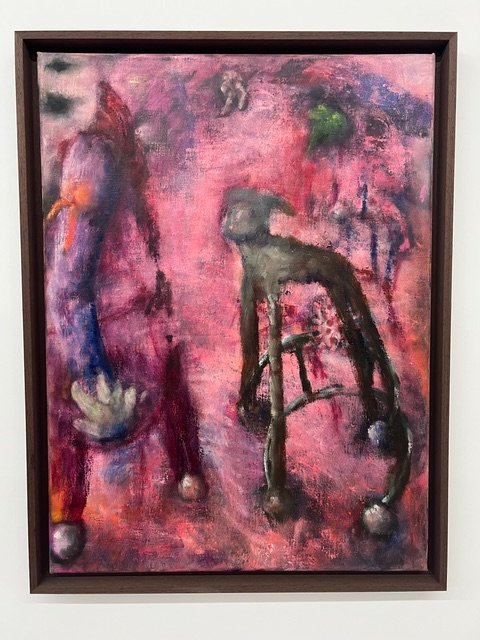
Mie Yim
Mie Yim’s paintings move between the visual language of manga and dreamlike, often abstract landscapes. Familiar cartoon-like figures appear in strange, fluid environments where bodies, colours and forms seem to drift between the recognisable and the imaginary. Her layered brushwork and unusual compositions give the works a psychological intensity, as if fragments of popular imagery were being reassembled by the subconscious. There is something both playful and unsettling about these paintings: they draw the viewer in through their vivid visual language, yet resist a single, fixed interpretation.
Nora Turato
Nora Turato has long explored the force of language through fragments of everyday speech, popular culture, the internet and the media. At Paris Internationale, what particularly caught my attention was her presentation of text through an organic visual language. Rather than treating words as neutral information or conventional typography, the forms give them a more fluid, physical presence.
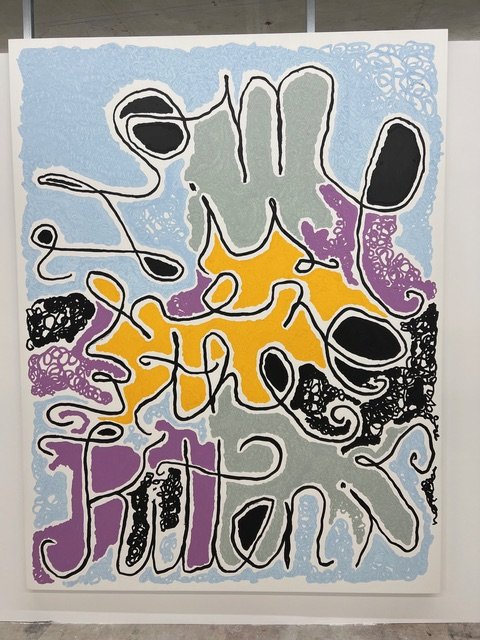
This approach creates an intriguing tension between language and shape. Words communicate, but they also become images in their own right, opening up questions about how meaning is constructed, how language circulates and how messages can change when removed from their familiar contexts.
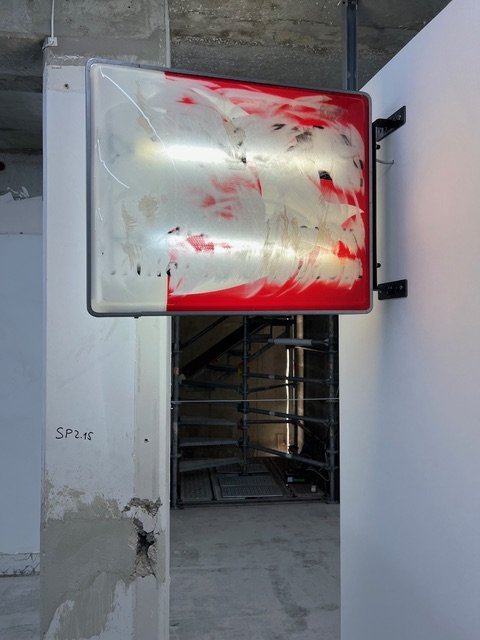
Jesse Darling
Jesse Darling, winner of the 2023 Turner Prize, creates sculptures and installations that often combine ordinary, discarded or industrial materials into fragile and precarious structures. His work explores vulnerability, the body and the systems — social, political and institutional — that shape our lives. There is something deliberately unresolved about these assemblages: they seem caught between holding together and falling apart, giving physical form to a world that is not always as stable as it appears.
Agata Ingarden
Agata Ingarden explores the intersection between the human body, technology and imagined futures. At Paris Internationale, her works brought together impressions of spinal vertebrae and components associated with an elevator shaft. The combination is striking: the vertebral column, the structure that supports the human body, is placed in dialogue with the mechanical framework of a machine designed to move people vertically through a building.
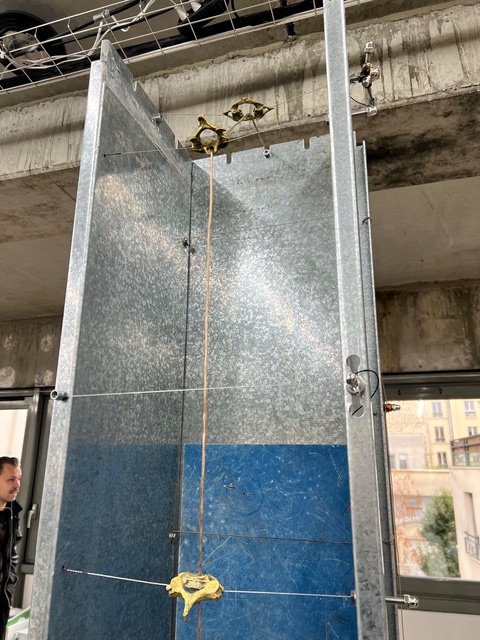
The works suggest a hybrid world in which biological and technological structures begin to overlap. What might initially appear to be an unlikely combination becomes a compelling reflection on how bodies and machines can share similar forms of support, movement and structural dependence. Ingarden's sculptures leave open the question of where the organic ends and the technological begins.
Pere Llobera
Pere Llobera approaches painting with an unusual combination of technical precision, conceptual reflection and dark humour. One of the works that caught my attention depicted two cars in an accident scene, based on an incident that had appeared in the press as a minor news item. An apparently ordinary event becomes the subject of a painting, removed from the fleeting context of the news and given a new visual presence.
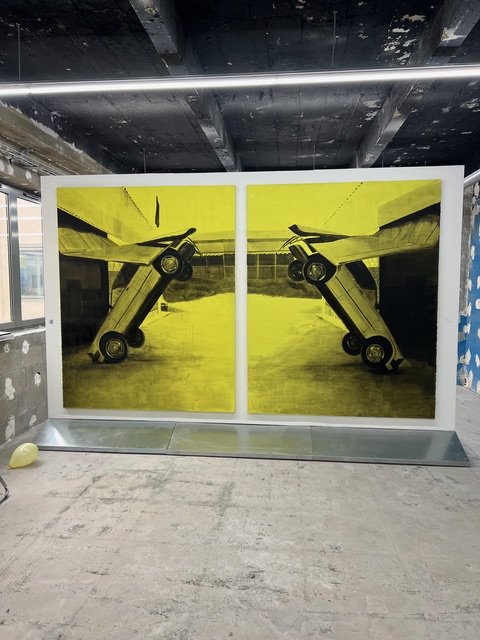
The pairing of the two cars also evokes the idea of doubling associated with Andy Warhol, whose repeated images transformed familiar subjects into striking artistic statements. In Llobera's painting, repetition and the transformation of an everyday incident invite us to question how images acquire meaning, and how something seemingly insignificant can become compelling when presented in a different context.
Catherine MacTavish
Catherine MacTavish's drawings offered one of the more introspective encounters at the fair. Rather than presenting the artist as a clearly defined subject, the works suggest an attempt at self-removal or self-erasure. The act of drawing seems to become a way of withdrawing from one's own image, questioning the extent to which the self can be represented or perhaps even deliberately made absent.
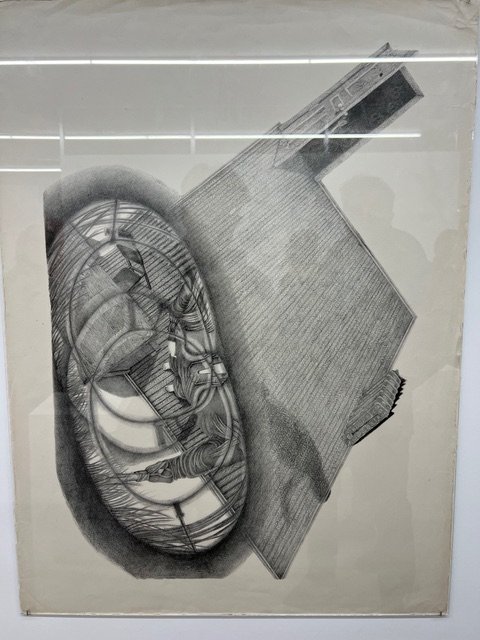
There is an intriguing tension between presence and disappearance. The artist is, of course, still there through the act of making the work, yet the drawings seem to explore the desire to efface that very presence. This sense of self-renunciation gives the works a quiet psychological intensity and invites reflection on identity, visibility and the possibility of stepping outside one's own representation.
The value of looking closer
What connects these artists is not a common style or subject matter. It is the sense that each has developed a distinctive visual or conceptual language, one that rewards time and attention.
That, ultimately, is what I appreciated most about Paris Internationale. In a week dominated by the scale and energy of major art fairs, it offered an opportunity to slow down and spend time with individual works. Its more intimate format allowed different artistic voices to stand on their own terms, without being overwhelmed by the sheer volume of the surrounding fair.
For me, the most memorable encounters were precisely those that resisted an immediate reading. They left questions open, invited a second look and continued to occupy the mind afterwards.
Sometimes, the most rewarding way to discover contemporary art is simply to give it more room.
Een werk verkopen, of weten wat het waard is? Wij maken vrijblijvend een inschatting.Selling a work, or want to know what it is worth? We make a no-obligation estimate.
Gratis waardebepalingFree appraisal