Meer over dit werkMore about this work
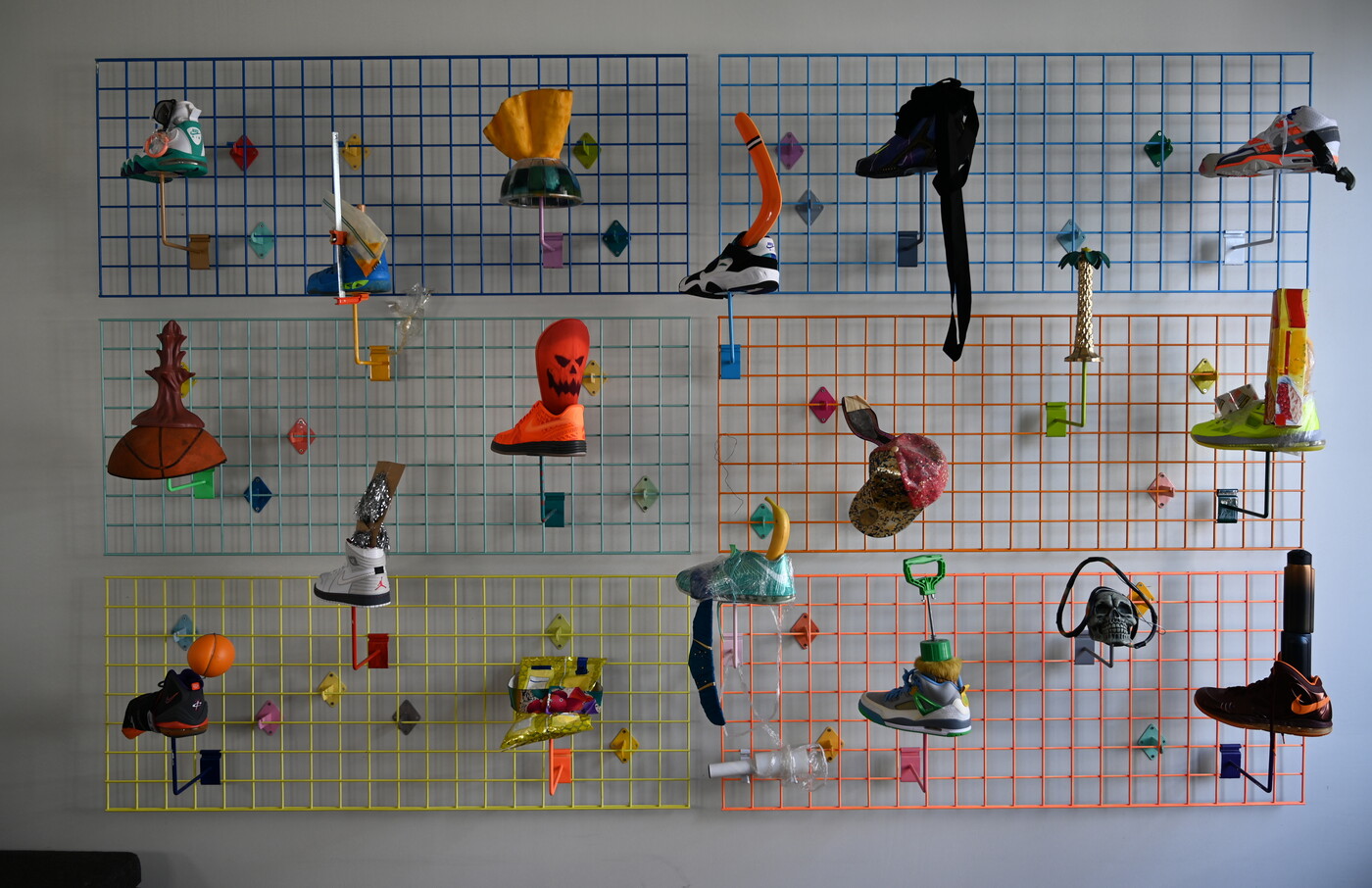
Metal gridwalls, enamel paint, display brackets, and an accumulation of found and consumer objects, including Nike basketball sneakers, sunglasses, shampoo and conditioner bottles, a basketball, Halloween masks, plastic toys, artificial coral, a mannequin hand, a rubber banana, a sequined baseball cap, a high-heeled shoe, a plastic skull, a rubber snake and other everyday materials. Overall dimensions: 80 × 125 × 10 inches (203 × 318 × 25 cm).
Head is an early and particularly revealing work in Alex Da Corte's practice. Six brightly coloured metal grid panels form a modular, retail-like structure onto which an unruly constellation of consumer objects is attached. The work immediately evokes the architecture of the shop, the display rack and the sports store, yet the objects have been removed from their ordinary function and transformed into a sculptural vocabulary.
The Nike basketball shoes are especially significant. Arranged like precious objects on a display system, they occupy the ambiguous territory between commodity, fetish object and sculpture. Their cultural associations — sport, aspiration, celebrity, street culture, status and consumption — are brought into proximity with deliberately banal or absurd objects: shampoo bottles, plastic toys, masks, a mannequin hand, a rubber banana and a sequined cap. Da Corte does not simply critique consumer culture; rather, he inhabits it, collecting and recombining its images and objects to reveal the strange psychological charge they already possess.
The coloured grids provide an underlying order, while the objects introduce excess, humour and instability. The work therefore oscillates between classification and chaos, retail display and museum display, commodity and artwork. In this sense, the grid is not merely a support but part of the work's conceptual structure: it converts the logic of merchandising into an exhibition system and, ultimately, into a kind of three-dimensional picture plane.
The title Head is equally suggestive. There is no conventional head or portrait; instead, the work can be read as a portrait of a contemporary consumer consciousness, assembled from the objects, images, desires and cultural references that circulate through everyday American life. The "head" is dispersed across the grid, constructed from things that have acquired emotional and symbolic value through popular culture.
Created in 2013, Head belongs to a crucial early phase of Da Corte's career, when he was developing the vocabulary that would underpin much of his later work: found objects, consumer culture, popular imagery, saturated colour, surreal juxtaposition and the transformation of familiar things into uncanny sculptural environments. The work is especially significant because it already contains the tension between high and low culture that would become central to Da Corte's mature practice.
Seen retrospectively, Head can therefore be understood not simply as an early assemblage, but as a blueprint for Da Corte's later artistic language. The same impulse — to take culturally loaded objects, detach them from their original context and recombine them into an immersive, psychologically charged world — would later expand into his large-scale installations, films and environments.
First presented by Joe Sheftel Gallery at NADA New York in 2013, Head was singled out by contemporary critics as one of the notable works of the fair.