Meer over dit werkMore about this work
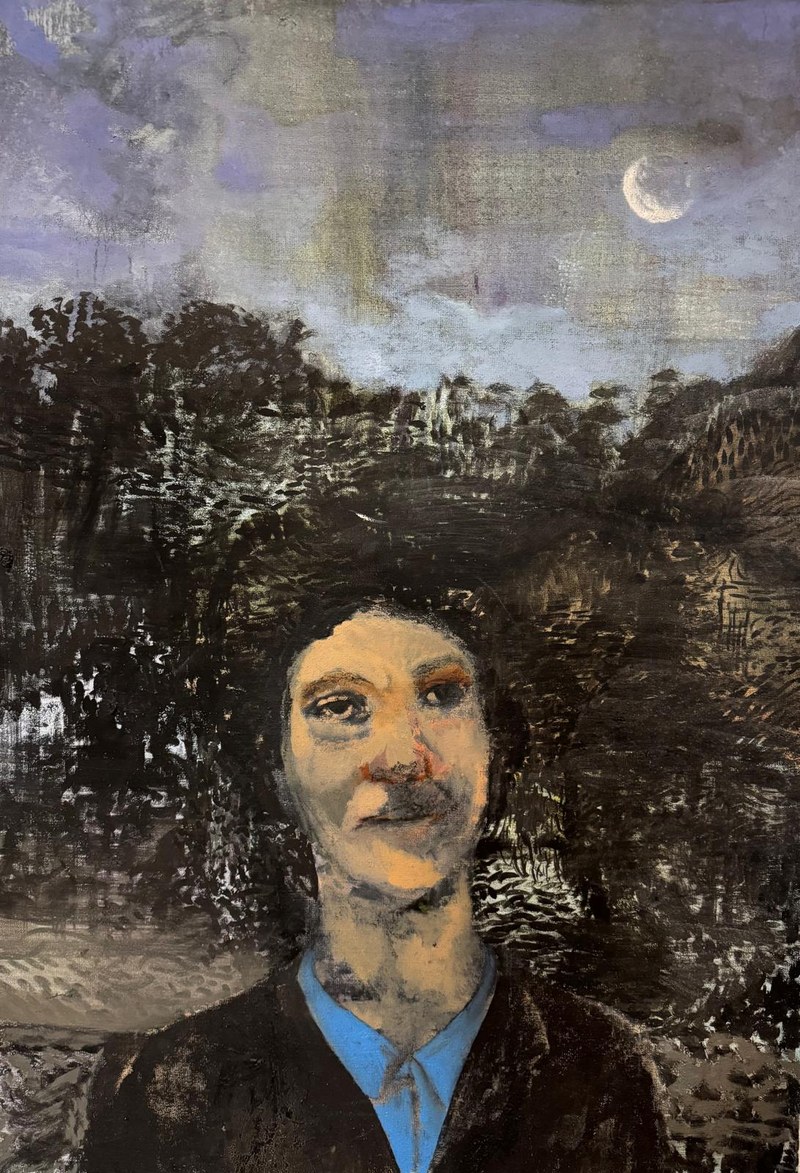
In Blue Moon, Stanislava Kovalcikova places a solitary, almost enigmatic figure against a nocturnal landscape. The calm frontal pose of the young man contrasts with the dense, shadowy vegetation behind him, while a thin crescent moon hangs almost improbably in the pale blue-grey sky. The scene feels familiar and yet strangely displaced: less a depiction of a real landscape than a fragment of an elusive dream.
There is an unmistakable echo here of the dream worlds of René Magritte. The juxtaposition of an ordinary human figure, a recognisable landscape and a moon suspended in an otherwise plausible sky recalls Magritte's ability to make the everyday appear quietly impossible. Yet Kovalcikova's atmosphere is more psychologically charged. Her figure does not simply inhabit the landscape; he appears to be emerging from it, or perhaps to be part of the same subconscious space.
This tension between the recognisable and the uncanny is central to Kovalcikova's practice. Her paintings frequently construct theatrical, mysterious worlds in which figures, objects and environments seem to exist somewhere between memory, myth and psychological experience.
Kovalcikova's paintings also reveal a striking dialogue between historical painting and contemporary sensibility. She studied at the Kunstakademie Düsseldorf with Tomma Abts and Peter Doig, two very different painters who nevertheless share an interest in ambiguity, constructed pictorial space and the psychological potential of landscape.
Seen from this perspective, Blue Moon can be understood as an early and particularly poetic example of Kovalcikova's fascination with the space between reality and fiction. The moon is not merely a detail in the landscape: it functions almost as a portal into another register of consciousness. The blue shirt of the figure subtly echoes the colour of the sky, further merging the person with his surroundings and reinforcing the sensation that we are looking at an interior state rather than simply a portrait.
The painting also gains additional significance when seen against Kovalcikova's trajectory today. Born in Slovakia in 1988 and now working between Paris and Düsseldorf, she has established an increasingly international presence, with exhibitions in London, Berlin, Shanghai, New York and elsewhere. In 2026 she was selected as the laureate of the Reiffers Art Prize, following a solo exhibition at Kunstverein Freiburg. Her work has also been presented at Art Basel and Frieze, signalling a rapidly expanding institutional and market presence.
Painted in 2018, Blue Moon also offers an interesting insight into Kovalcikova's development. Many of the qualities that have become central to her work today (mystery, theatricality, references to art history and psychological ambiguity) are already clearly present here.